Back to Blog
Comfort Shoes Foot Biomechanics Natural Movement Walking Shoes Arch Support
How to Tell If a Shoe Is Really Comfortable
by REVITALIGN JOURNAL Research & Editorial Team – Revitalign Europe|
Have you ever tried on a pair of shoes that seemed perfect... but only for a few minutes?
It happens more often than you’d think.
You put them on for the first time and they feel great: the sole is soft, the fit is comfortable, and everything seems to promise exceptional comfort.
Then reality sets in.
After a few hours on your feet, a walk around town, or a full day at work, that same shoe just doesn’t feel the same anymore.
Why?
Many people think that comfort depends solely on the softness of the sole.
In reality, our feet need much more than that.
Comfort isn’t measured in the first five minutes
When we try on a new shoe, our judgment is based mainly on our initial impressions.
But true comfort is measured over time.
A good shoe remains comfortable even after thousands of steps, when the foot is under constant strain and the body begins to tire.
For this reason, modern footwear designers don’t just evaluate cushioning; they study how the shoe interacts with the foot’s natural movement throughout the entire walking cycle.
Softness and support are not the same thing
A very soft sole can provide a pleasant initial sensation.
However, research on the biomechanics of walking shows that comfort is influenced by several factors that work together.
A comfortable shoe should provide a balance between:
foot support;
stability during the gait cycle;
flexibility where needed;
even pressure distribution;
materials that maintain comfort over time.
In other words, softness is important, but it’s not enough on its own.
Did you know?
During a typical day, we can take between 5,000 and 10,000 steps.
Each step represents a new interaction between the foot, the shoe, and the ground. It is precisely this continuous repetition that makes a design capable of supporting the body’s natural movement essential.
The foot thrives on balance
Our foot isn’t designed to be completely immobilized, nor is it meant to move without any support.
As we walk, their function is constantly changing.
At times, it needs to be more flexible to adapt to the ground.
At other times, it must become stable to support the body’s weight.
A well-designed shoe accommodates this natural alternation without forcing the foot or restricting its movement.
It is precisely this balance that often makes a shoe feel truly comfortable even after many hours.
Arch support: an ally of movement, not a correction
When people hear the term “arch support,” many immediately think of an orthopedic shoe.
In reality, in modern comfort footwear, the concept is very different.
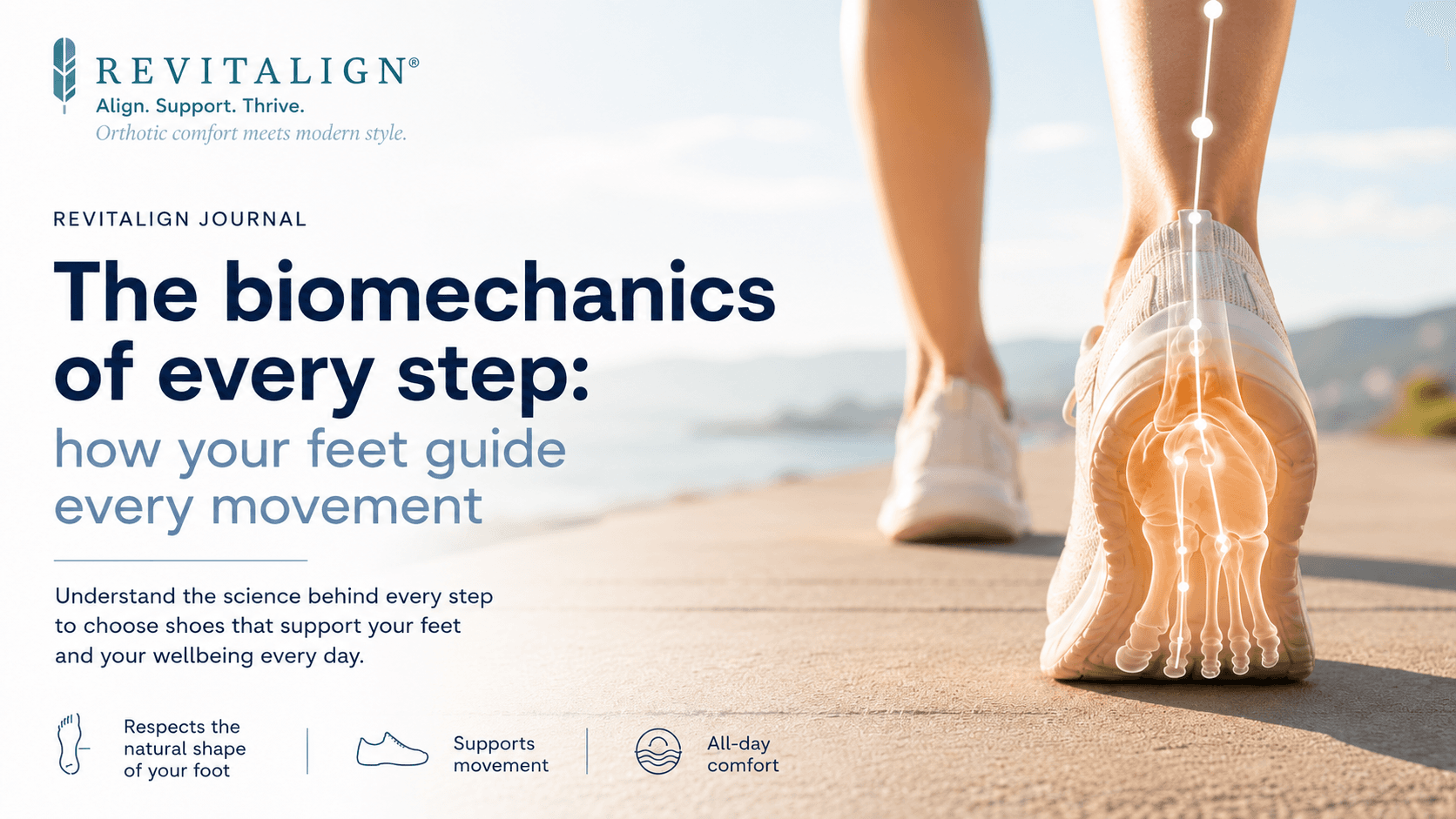
Arch support is not designed to alter the foot, but to support its natural function while walking.
Well-designed arch support helps distribute pressure more evenly and maintain a sense of stability without compromising natural freedom of movement.
For this reason, many comfort-focused shoes today incorporate solutions inspired by the biomechanics of gait.
The Revitalign Philosophy
It is precisely these principles that form the basis of Revitalign’s approach.
Each model is designed to support the foot’s natural movement through a balance of anatomical support, cushioning, lightness, and contemporary design.
The technologies developed by the brand, such as the Full Contact Comfort® Footbed, are designed to provide a comfortable feel that enhances daily walking without sacrificing style.
Because a shoe should adapt to the person, not the other way around.
What to Take Home
✔ Comfort doesn’t depend solely on the softness of the sole.
✔ A good shoe supports the foot’s natural movement.
✔ Support, stability, and flexibility work together.
✔ The best comfort is the kind you still feel even after many hours.
✔ Choosing a shoe means choosing how you’ll tackle thousands of steps every day.
Conclusion
Shoes are with us every moment of the day.
We wear them to go to work, travel, take walks, or simply go about our daily lives.
For this reason, true comfort shouldn’t be a feeling that lasts just a few minutes, but an experience that accompanies us step by step.
Understanding what truly makes a shoe comfortable means making more informed choices.
And this is precisely the philosophy that inspires Revitalign:
Align. Support. Thrive.
References
Research & Editorial Team – Revitalign Europe
This article was developed through an analysis of international scientific literature and authoritative sources dedicated to the biomechanics of walking, footwear comfort, and the sciences of movement.
Main Sources
Perry J., Burnfield J.M. Gait Analysis: Normal and Pathological Function. 2nd ed.
Neumann D.A. Kinesiology of the Musculoskeletal System.
American Academy of Physical Medicine and Rehabilitation – Biomechanics of Normal Gait.
Journal of Foot and Ankle Research.
Gait & Posture.
Share