Back to Blog
Foot Biomechanics Walking Shoes Comfort Shoes Arch Support Natural Movement
Why are some shoes comfortable all day long?
by Editorial Team – Revitalign |
Have you ever bought a pair of shoes that seemed perfect... but only for the first few minutes?
It happens more often than you’d think.
You try them on in the store; they feel soft, light, and comfortable.
Then reality sets in.
After a day at work, a walk around town, or a few hours spent on your feet, the comfort seems to disappear.
Why does this happen?
The answer doesn’t depend solely on the quality of the materials or the softness of the sole.
Very often, it depends on something we can’t see: the way the shoe supports the foot’s natural movement.
And this is precisely where the biomechanics of walking come into play.
Walking is much more complex than it seems
Every day we take thousands of steps.
We do it without even thinking about it.
Yet every single step is a small masterpiece of coordination.
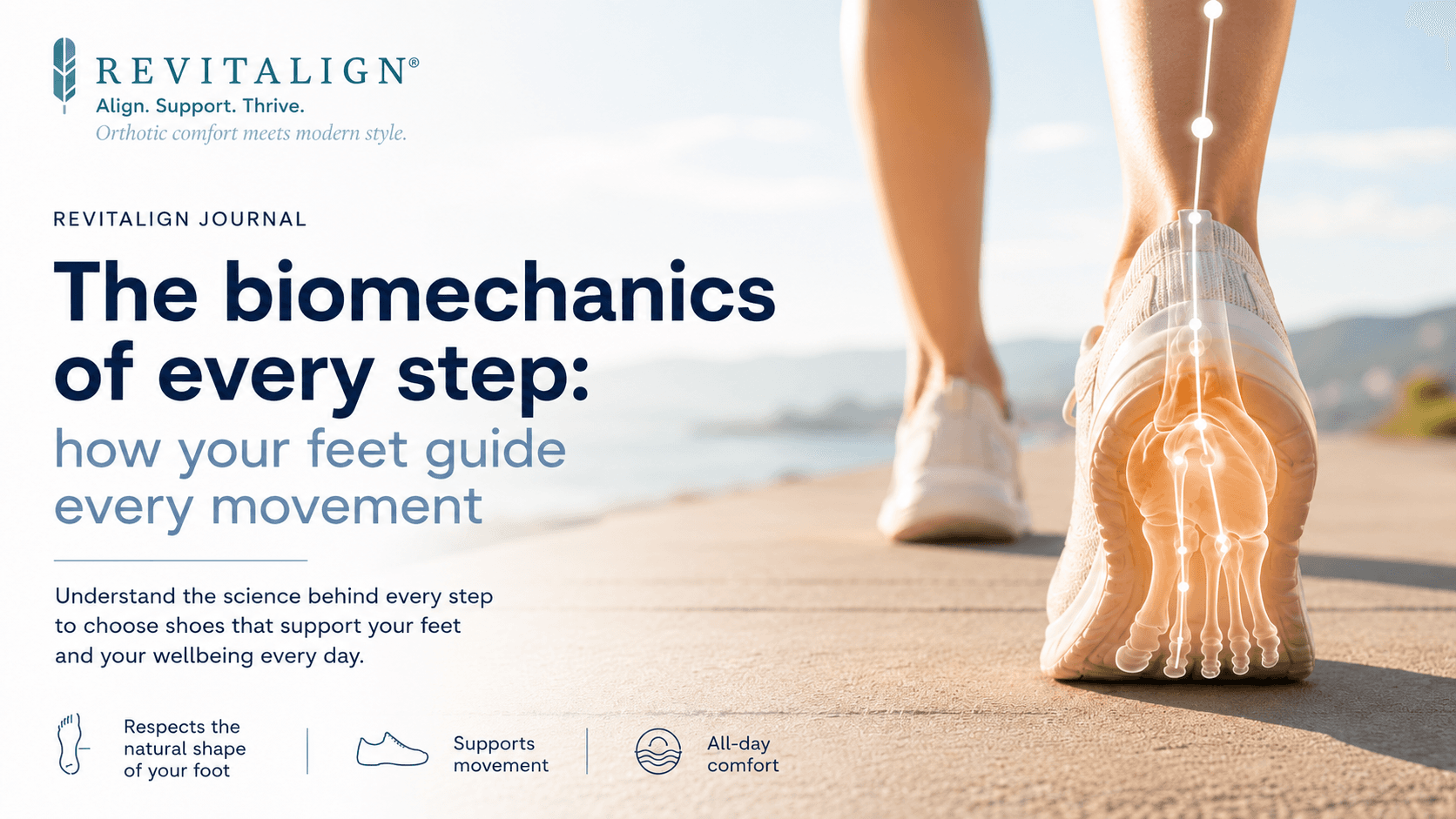
When the heel touches the ground, the foot begins to absorb the body’s weight.
A few moments later, its function changes.
It becomes stable.
Finally, it provides the push that propels us toward the next step.
All of this happens in less than a second.
And it repeats itself thousands of times throughout the day.
Specialists call this sequence the gait cycle, one of the most studied movements in human biomechanics.
The foot is constantly changing
Many people imagine the foot as a rigid structure.
In reality, it’s exactly the opposite.
While walking, the foot constantly adapts.
It is flexible when it needs to absorb the impact of contact with the ground.
It becomes stable when supporting the body’s weight.
Finally, it acts as a lever that allows us to move forward.
This ability to change function is one of the reasons why the human foot is considered one of the most sophisticated biomechanical structures in our body.
Comfort isn’t just about softness
When we talk about comfortable shoes, our first thought almost always goes to cushioning.
That’s normal.
A soft sole immediately conveys a pleasant sensation.
But that initial sensation doesn’t always match the comfort we feel after many hours.
Biomechanical research suggests that comfort stems from a balance between several factors:
- foot support;
- stability;
- pressure distribution;
- freedom of movement;
- quality of materials.
A good shoe should not force the foot to move differently.
It should simply support it.
Did you know?
The human foot consists of 26 bones, 33 joints, and over 100 muscles, tendons, and ligaments.
All these structures work together to allow us to walk naturally, constantly adapting to different surfaces and the demands of the day.
Why support really makes a difference
Every time we place our foot on the ground, our body weight is distributed through a complex network of anatomical structures.
Among these, the arch of the foot plays a fundamental role in contributing to stability and pressure distribution.
For this reason, modern footwear designed for comfort isn’t just about being soft.
They’re designed to provide support that complements the foot’s natural movement without restricting its function.
The goal isn’t to change the way we walk, but to respect the foot’s natural physiology.
A New Concept of Comfortable Footwear
In recent years, the concept of comfort has evolved.
It’s no longer enough to simply make a lightweight or well-cushioned shoe.
More and more designers are studying the biomechanics of walking to develop footwear capable of following the foot’s natural movement.
It’s an approach that puts the person first, even before the shoe.
And it is precisely from this philosophy that Revitalign was born.
Each model is designed based on a simple principle:
a truly comfortable shoe should work in harmony with the foot, not in its place.
This means providing balanced anatomical support, a smooth stride, and comfort that lasts all day long—without sacrificing style or lightness.
✔ The foot constantly changes its function with every step.
✔ Comfort doesn’t depend solely on the softness of the shoe.
✔ Good footwear supports the foot’s natural movement.
✔ Understanding these principles helps you choose shoes that are better suited to your lifestyle.
Conclusion
Every day, our feet take us everywhere.
We use them without thinking about it, until they start asking for a little more attention.
Understanding how the foot’s natural movement works means making a more informed choice when it’s time to buy a new pair of shoes.
Because true comfort doesn’t come from a soft sole alone.
It comes from the balance between our body and what we wear.
This is the philosophy that inspires every Revitalign shoe.
Align. Support. Thrive.
References
Research & Editorial Team – Revitalign Europe
This article was developed through an analysis of international scientific literature on the biomechanics of walking and foot comfort.
Main Sources
Perry J., Burnfield JM. Gait Analysis: Normal and Pathological Function. 2nd Edition.
Neumann DA. Kinesiology of the Musculoskeletal System.
Buldt AK et al. The relationship between foot posture and lower limb kinematics during walking. Gait & Posture (2013).
American Academy of Physical Medicine and Rehabilitation – Biomechanics of Normal Gait.
Journal of Foot and Ankle Research.
Share